
Radon Testing
Radon testing is the only way to know whether your home has a radon problem. Our certified testing uses continuous electronic monitors for an accurate 48-hour test, with your results as soon as we pick up the monitor.
We test homes in Raleigh, Cary, Durham and the surrounding area. You can schedule radon testing on its own or add it to your home inspection.
Why Every Home Should Be Tested for Radon
The U.S. Surgeon General recommends all homes be tested for radon gas. Breathing radon in your home can cause lung cancer. Radon is a naturally occurring radioactive gas released in rock, soil and water that can build up to dangerous levels inside any home; this means new and old homes, well sealed and drafty homes and homes with a crawlspace, slab or basement.
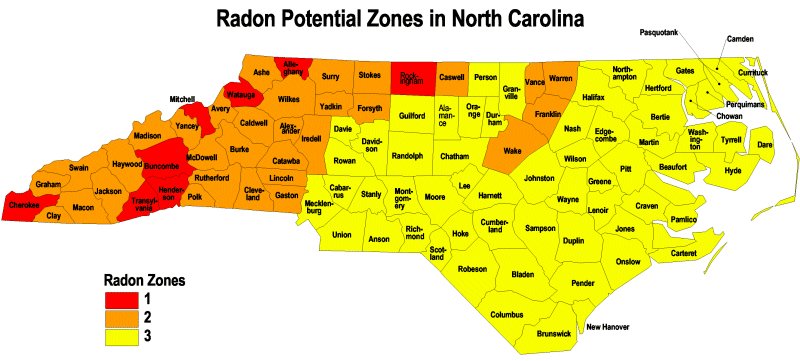
Radon Is Found All Over North Carolina
Homes with high levels of radon have been found in every state and all across North Carolina. Wake County, our most populated area, is in fact a Level 2 zone for radon, as is neighboring Franklin County. Radon gas is odorless and invisible, and the only way to know if your home has a radon problem is to test for it.

Understanding Radon Levels
Radon levels can vary greatly from home to home. Even levels next door can be very different. Radon is measured in picocuries per liter of air (pCi/L), a measurement of radioactivity.
- Average indoor level in the United States: about 1.3 pCi/L
- Average outdoor level: about 0.4 pCi/L
- 4 pCi/L or higher: the U.S. Surgeon General and EPA recommend fixing the home
- 2 to 4 pCi/L: EPA recommends that people think about fixing their homes
How We Test for Radon
A certified radon specialist should test your home for radon. Testing your house for radon is easy. If your house has a radon problem, it can be fixed, and fixing it reduces the risk of lung cancer for you and your family.
Triangle Inspection Group uses only the most advanced equipment available for radon testing. We only use continuous electronic monitors, the Airthings Corentium Pro, a fully AARST-NRPP and NRSB certified product for radon professionals.
- Four highly accurate radon chambers that work in parallel for maximum performance, reliability and speed
- Built-in tamper detection
- Hourly readings of radon, temperature, humidity and barometric pressure
There is no better equipment to use when testing your home for radon. See a sample radon report.

Radon Testing FAQs
How does radon testing work?
We place a continuous electronic radon monitor in your home for the standard 48-hour test. The monitor measures radon, temperature and humidity levels the whole time and has built-in tamper detection, so you can trust the result. We will explain how to prepare the home before the test.
How long does a radon test take?
The standard test runs 48 hours. You get your results as soon as we pick up the monitor.
What level of radon is too high?
The U.S. Surgeon General and the EPA recommend fixing homes with radon levels at or above 4 pCi/L. The EPA also recommends that you consider fixing your home for levels between 2 and 4 pCi/L. For comparison, the average indoor level in the United States is about 1.3 pCi/L.
What happens if my radon test is high?
You receive a report with your measured levels. A radon problem can be fixed, and fixing it reduces your family’s risk of lung cancer. We only test and do not perform radon remediation, so our results are independent. You can get quotes from a certified radon mitigation professional of your choice.
Do I need a radon test if my home is new, or my neighbor’s test was low?
Yes. Radon can be in any home, new or old, tightly sealed or drafty, with a slab, crawl space or basement. Levels can vary greatly from house to house, so a neighbor’s result does not tell you about yours.
Can I schedule radon testing by itself?
Yes. You can add radon testing to a home inspection or schedule it as a stand-alone visit. A stand-alone visit may include a small trip fee based on travel distance.
What areas do you serve?
We perform radon testing across the central Triangle, with local service areas that include:
- Raleigh, Cary & Morrisville
- Apex, Pittsboro & New Hill
- Garner, Fuquay-Varina & Holly Springs
Based in Cary, we also serve most other surrounding communities in Wake, Durham and Chatham counties, including Sanford. Call 919-247-2617 or check the online scheduler for our availability. See all areas we serve.